
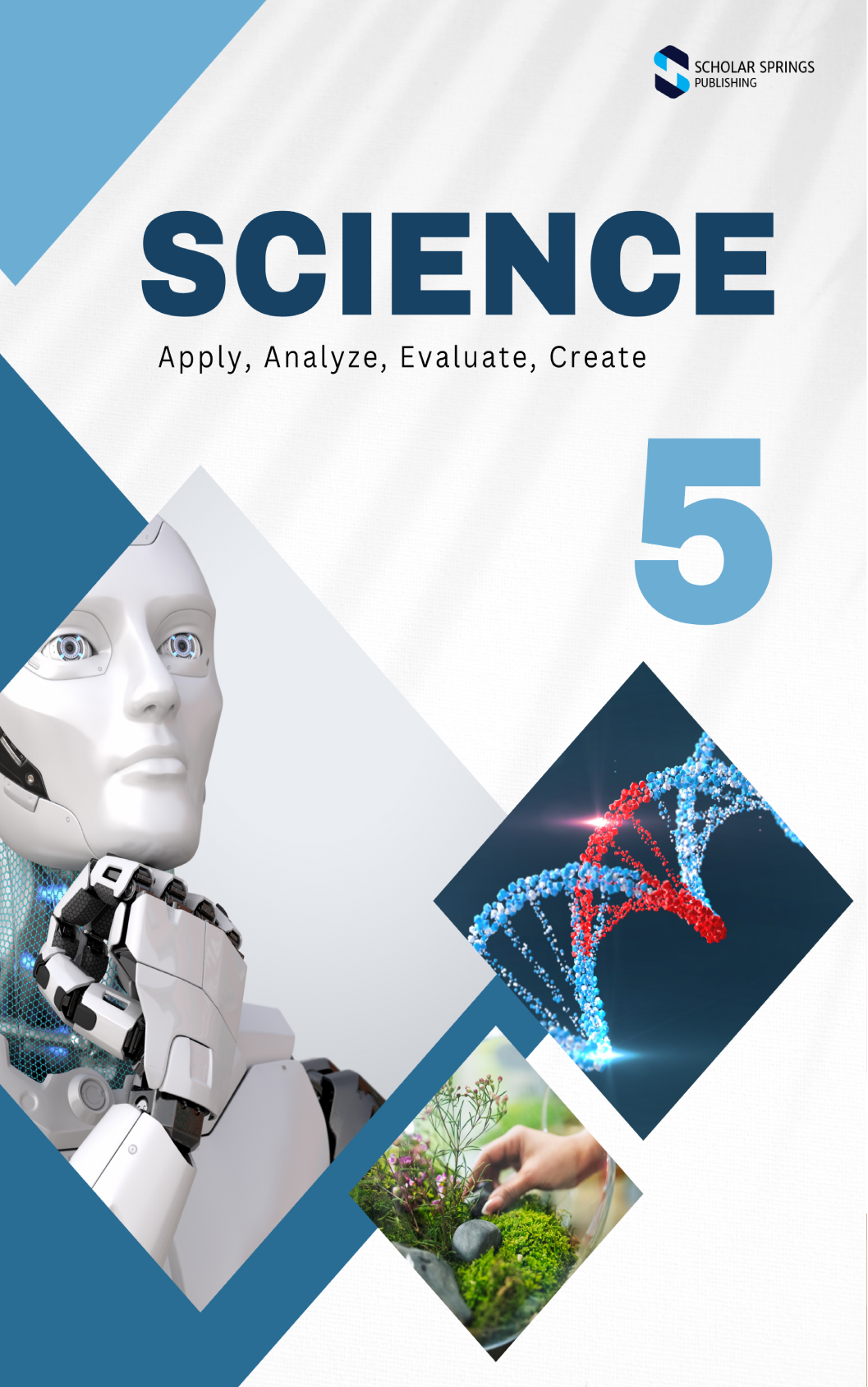
A Complete Curriculum (NGSS Aligned)
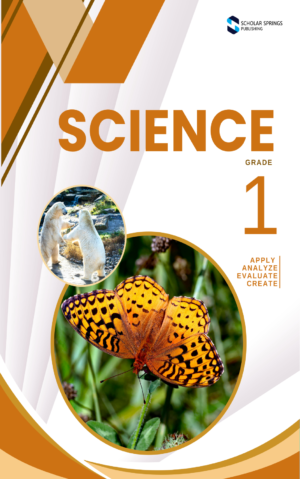
Grade 5 Science: A Complete Curriculum is a comprehensive program designed to develop students’ understanding of the natural and physical world through investigation, experimentation, and critical thinking. Carefully aligned with the Next Generation Science Standards, this textbook provides a structured progression of lessons that guides students in exploring life sciences, physical sciences, Earth systems, and emerging technologies.
The curriculum supports classroom teachers and homeschool educators with clear instruction, hands-on experiments, collaborative activities, and inquiry-based learning. Lessons are designed to follow the progression in Benjamin Bloom’s Bloom’s Taxonomy, helping students move from remembering and understanding concepts to applying, analyzing, evaluating, and creating scientific solutions.
Students explore core concepts such as cells, forces, ecosystems, Earth’s systems, genetics, robotics, artificial intelligence, and astronomy. Activities encourage critical thinking, problem solving, and real-world applications, preparing students to understand complex systems and scientific relationships.
Units and Topics Covered
UNIT 1 – Cells and Organisms
-
What are Cells? Basic Structure and Function
-
Plant vs. Animal Cells
-
Cells to Tissues to Organs to Systems
-
Photosynthesis and Cellular Respiration
-
Life Functions: Growth, Reproduction, and Response
-
Human Body Systems (Digestive, Respiratory, Circulatory)
UNIT 2 – Properties and Changes of Matter
-
Properties of Matter and Observing Matter
-
Physical and Chemical Changes
-
Mixtures and Solutions: Solubility and Separation Techniques
UNIT 3 – Forces and Motion
-
Newton’s Laws of Motion
-
Gravitational and Frictional Forces
-
Balanced and Unbalanced Forces
UNIT 4 – Ecosystems and Adaptations
-
Ecosystems and Energy Flow
-
Adaptations and Survival
-
Human Impact and Sustainable Ecosystems
-
Endangered Species and Conservation
UNIT 5 – Earth’s Systems
-
Introduction to Earth’s Systems
-
Water Cycle and Hydrosphere
-
Atmospheric Layers and Weather Patterns
-
Geosphere, Plate Tectonics, and Interactions
-
Human Impact on Earth’s Systems
UNIT 6 – Artificial Intelligence and Its Applications
-
What is AI?
-
Machine Learning and Data
-
AI in Everyday Life, Science, Medicine, Transportation, and Space
-
Ethical Issues and the Future of AI
UNIT 7 – Robotics and Automation
-
Introduction to Robotics
-
How Robots Work (Sensors, Actuators, Processors)
-
Robotics in Daily Life, Space, Medicine
-
Coding, Programming, and Ethics
UNIT 8 – Genes and DNA (Basic Introduction)
-
What is DNA? How Genes Work
-
Inherited vs. Acquired Traits
-
Variation in Traits
-
DNA in the Human Body and Future Applications
UNIT 9 – Animal Food Chain
-
Food Chains, Producers, Consumers, Decomposers
-
Herbivores, Carnivores, Omnivores
-
Food Webs, Energy Pyramids, and Conservation
UNIT 10 – Stars and Constellations
-
What Are Stars and Their Types
-
Constellations and the North Star
-
Star Movement, Modern Astronomy, and Exploration
Reviews
There are no reviews yet.